
Underground Cable Installation in West Malling
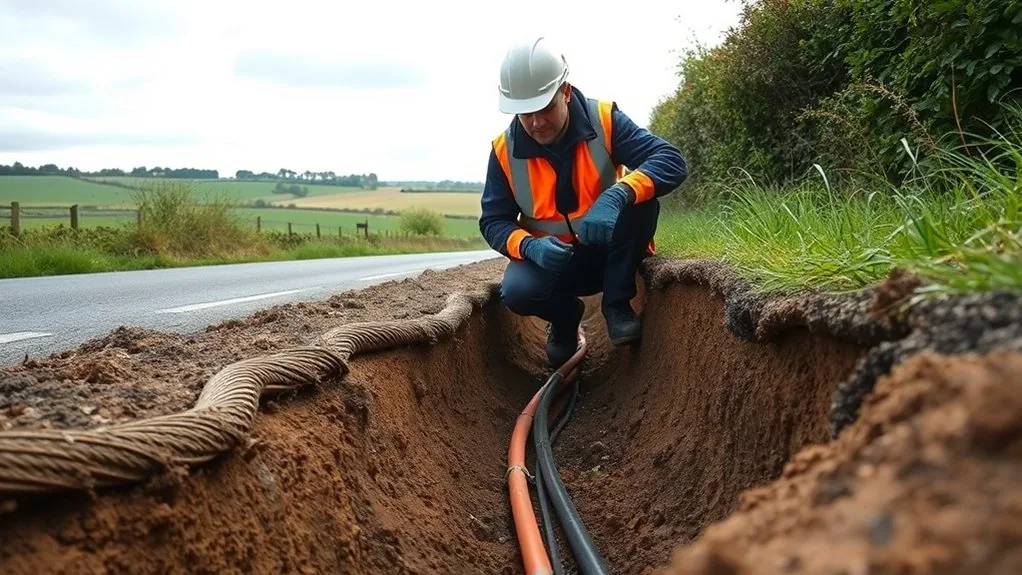
Underground cable installation can be complex, with risks of faults and disruptions if not done to the correct depths and standards.
Ensuring cables are installed with proper ducting, terminations, and certified testing helps maintain reliable power and data supply while complying with UK regulations.
For a fast quote or emergency callout in West Malling, please get in touch.
Although it’s often hidden from view, underground cable installation is the controlled process of routing and protecting electrical or communication conductors below ground level using engineered methods such as trenching, ducting, or directional drilling. You’re creating a stable, low-risk pathway that shields services from weather, impact, and accidental damage.
You start by surveying the route, locating existing utilities, and selecting suitable cable materials based on voltage, data capacity, soil conditions, and moisture exposure. You then design depths, separation distances, and mechanical protection to match local and national safety regulations. Conduits, ducts, or protective tiles are positioned precisely before cables are pulled or jetted through. Finally, you test insulation resistance, verify earthing, document as‑built positions, and reinstate the surface to a safe standard.
When overhead wiring becomes impractical, unsafe, or non‑compliant, you need to plan an underground cable installation to maintain supply reliability and meet regulatory standards. You’re typically driven to this option by site constraints, risk conditions, or strict planning obligations in West Malling.
You’ll especially need underground solutions when you must:
In each case, underground routing lets you engineer safer, longer‑life power and data connections with predictable performance.
When you’re ready to install underground cabling in West Malling, you’ll follow a structured sequence that starts with a detailed site survey and planning to map existing services and assess ground conditions. From there, you’ll progress through controlled trenching and duct laying, followed by precise cable placement and jointing using approved materials and methods. Finally, you’ll complete rigorous testing and final commissioning to verify electrical performance, safety compliance, and long-term reliability.
Before a single trench is opened, a disciplined site survey and planning phase defines how your underground cable installation in West Malling will proceed safely and efficiently. You’ll have existing services located, access constraints mapped, and load requirements calculated so the final layout balances safety, performance, and cable aesthetics while minimising surface disruption.
| Planning Aspect | What It Establishes |
|---|---|
| Utility records | Position of gas, water, telecoms, and LV/HV circuits |
| Topographical survey | Ground levels, obstructions, drainage paths |
| Soil and ground type | Bearing capacity, corrosion risk, protection needs |
| Route optimisation | Shortest safe path, segregation from other services |
| Compliance review | BS 7671, DNO, and local authority requirements |
Although the planning work happens above ground, trenching and duct laying is where your underground cable installation in West Malling starts to interact with soil, structures, and existing services. You’ll define trench alignment, depth, and width to comply with utility maps, separation distances, and local authority requirements.
Before excavation, you’ll implement trench safety measures: shoring, trench boxes, or battering sides according to soil type and depth. Spoil heaps are kept clear of edges and pedestrian routes are controlled.
Ducts are then laid to a specified gradient, avoiding sharp bends that could damage cable insulation later. You’ll install sand or fine backfill bedding, position ducts with spacers, and place marker tape above. Final backfill is compacted in layers to prevent settlement and protect future access routes.
Once ducts are proven clear and correctly aligned, cable placement and jointing become the critical stages that determine the long‑term reliability of your underground cable installation in West Malling. You’ll pull cables through each run using calculated tension limits, guaranteeing sheath integrity and avoiding micro‑bending that can cause premature failure.
| Step | Focus |
|---|---|
| 1 | Verify conduit placement and depth against design drawings |
| 2 | Control pulling tension, side‑wall pressure, and bend radii |
| 3 | Prepare ends for cable jointing in a clean, dry environment |
| 4 | Apply mechanical protection and identification to every joint |
Cable jointing demands strict adherence to manufacturer instructions, including stripping dimensions, crimping forces, and heat‑shrink or cold‑shrink application. You’ll maintain phase alignment, earth continuity, and moisture sealing to ensure durable, low‑resistance connections.
With all cables placed and joints completed to specification, the installation still isn’t ready to energise until it’s been rigorously tested and commissioned. You’ll begin with continuity and insulation resistance tests to verify conductor integrity and cable insulation performance against design values. High-voltage pressure testing may then be applied to prove long-term dielectric strength without overstressing the system.
Next, you’ll test earthing, bonding, and fault-loop impedance to confirm disconnection times and touch-voltage safety. Protection relays, switchgear, and monitoring devices are then function‑tested, including simulated fault conditions.
You’ll also confirm power redundancy paths by switching between primary and backup feeds, ensuring critical loads remain supplied. Finally, all test results are documented, signed off, and used to issue formal commissioning certification.
When you’re planning a new power or data route in West Malling’s constrained streets and mixed ground conditions, choosing between modern underground cable installation methods and traditional open‑cut excavation directly influences safety, project duration, cost, and surface disruption. You’ll assess soil type, existing utilities, access, and required capacity before selecting a technique.
With traditional excavation, you rely on open trenches, straightforward visual inspection, and simple jointing, but you typically face longer traffic management and reinstatement periods. Modern trenchless options use guided boring or mole ploughing to reduce surface impact while still complying with strict safety standards, bedding specifications, and separation distances. You’ll also evaluate cable durability, considering depth, thermal backfill, and mechanical protection to ensure long‑term, low‑risk operation.
Having compared trenchless techniques to open‑cut excavation, you can focus on why underground cable installation often delivers a better whole‑life outcome for West Malling projects. By placing services below ground, you’re engineering a controlled environment where loadings, moisture, and impact risks are predictable and manageable.
You gain:
Across West Malling’s built environment, underground cable installation underpins both routine domestic connections and complex commercial power networks, but each setting demands a tailored engineering approach. In homes, you’re typically routing low‑voltage power and data to extensions, EV chargers, and outbuildings, with careful depth control, segregation of services, and protection against garden works to maximise cable durability and minimise environmental impact.
In commercial premises, you’re dealing with higher loads, diversity factors, and business‑critical resilience, so designs must integrate load calculations, fault levels, and coordinated protection.
| Setting | Key Technical Focus | Risk Priority |
|---|---|---|
| Domestic | Safe routing, future access | DIY strikes, moisture ingress |
| Commercial | Load capacity, redundancy | Downtime, regulatory breaches |
| Shared Use | Segregation of power/data | Interference, overheating |
| All Sites | Cable durability, reinstatement | Environmental impact, public safety |
Although every project is unique, our underground cable installation service in West Malling follows a disciplined process that prioritises safety, compliance, and long‑term reliability. You’ll see this from initial site survey through to final testing and documentation.
We begin by mapping existing utilities, evaluating ground conditions, and defining cable routes to optimise performance and cable durability. Trench depth, separation, and protective ducting are specified to meet relevant UK regulations and strict safety standards. Where required, we design for load diversity, fault levels, and future capacity.
During installation, we maintain controlled excavation, correct bedding materials, and moisture protection to prevent mechanical and environmental damage. Cables are terminated and jointed using certified methods, then tested for insulation resistance, continuity, and earth fault performance before being energised.
When you’re selecting a contractor for underground cable installation in West Malling, you need a team that understands not just how to lay a cable, but how to engineer a safe, resilient system from first principles. You want disciplined survey work, accurate load assessments, and compliant routing that minimises conflict with existing services.
We design and install with cable safety as the primary constraint, not an afterthought. That means correct depth, separation, bedding, warning tapes, and jointing methods aligned with BS standards and DNO specifications. You also benefit from our focus on Environmental impact: reduced trench widths, optimised routes, and reinstatement that preserves drainage patterns and soil structure. Every stage is documented, inspected, and tested, giving you predictable performance and long-term reliability.
You’ll likely want clear answers on how long underground cable installation will take, whether it’s more cost‑effective than traditional trenching, and if your specific location in West Malling is covered. In this section, we’ll address these questions using realistic timescales, cost considerations, and defined service areas. That way, you can plan your project with accurate expectations for programme duration, budget, and site accessibility.
In practice, the duration of an underground cable installation in West Malling depends on cable length, route complexity, ground conditions, and required permissions, but most domestic projects typically span from a single day to several days on site. You’ll also need to factor in design checks to confirm cable durability, load capacity, and installation safety before any excavation begins.
A straightforward power feed to a garden office or garage, with easy access and clear underground services, can often be completed in one working day. More complex runs involving highways, shared access, or multiple service crossings may extend to a week or more, particularly if traffic management or staged working is required. Lead‑in times for utility searches, permits, and inspections can add several days to the overall schedule.
Cost naturally sits alongside timescales, so it’s sensible to ask whether underground cable installation works out cheaper than simply digging a trench yourself. Upfront, professional installation can look pricier, but once you factor in reinstatement, compliance, and long‑term Cable durability, DIY digging often proves a false economy.
| Factor | DIY Digging Only | Professional Underground Install |
|---|---|---|
| Initial Outlay | Low labour, basic tools | Higher, includes plant and materials |
| Installation Safety | Higher risk of strikes, non‑compliance | Planned routes, utility checks, permits |
| Long‑Term Costs | More faults, remedial works | Fewer failures, predictable maintenance |
| Overall Value | Cheap initially, uncertain lifecycle | Optimised lifecycle cost and reliability |
Over a cable’s service life, a methodical, standards‑compliant install is usually more cost‑effective.
Wondering if your part of West Malling is within our coverage zone is a practical place to start, because site access and network constraints directly affect feasibility and cost. We cover most of West Malling, including urban streets, rural land, farms, industrial estates, and coastal properties, but we always verify access, ground conditions, and existing utilities before confirming.
You’ll get a clear answer once we review your full postcode, site layout, and load requirements. We then assess soil type, cable route length, and jointing points, as these influence cable durability, voltage drop, and installation method.
Where we can’t safely work or where the environmental impact would be disproportionate, we’ll explain the constraints and, where possible, propose compliant alternatives or phased works.
You usually do not need planning permission to install underground cables on your property in West Malling. However, you may require trenching permits and must follow building regulations. It is important to carry out utility searches, use safe digging practices, install correct ducting, and ensure certified termination. If the installation crosses highways, shared access areas, or conservation zones, check with the local planning authority before proceeding.
Power or data cables should be installed at least 1 to 1.5 metres away from tree trunks and large hedges. This distance helps prevent damage from tree roots and future excavation. For other services, maintain minimum separations according to BS 7671 and local utility guidelines, usually 150 to 300 mm horizontally with appropriate depth.
Yes, existing overhead lines can usually be converted to underground without interrupting your supply. Engineers install and test the new underground cables before switching the service to minimise outage time. The process involves higher installation costs, detailed route surveys, and safety clearances, which should be balanced against benefits like improved aesthetics, reliability, and reduced long-term maintenance.
Periodic maintenance after underground cable installation includes visual inspections of terminations, accessible joints, and marker tape to ensure their condition and durability. Formal inspection schedules should include thermographic checks of link boxes, earth testing, and monitoring insulation resistance. Additionally, inspect pits for water ingress, corrosion, and mechanical damage, and keep as-built drawings accurate and updated after any work. If voltage fluctuations, tripping, or ground faults occur, arrange immediate diagnostic testing.
There are no specific insurance requirements solely because power and data lines are buried. However, your insurer may change your coverage and liability terms. It is important to notify your insurer, ensure your policy includes accidental excavation damage, third-party injury, and service interruption, and check that contractors have suitable public liability and professional indemnity insurance.
Although every project is unique, you can obtain a precise quote for underground cable installation in West Malling by providing a few key details: site location and access constraints, required cable type and size, route length, existing utilities, ground conditions, and any specific compliance or testing requirements. You’ll also need to clarify voltage level, load profile, and Cable insulation specification so your Power distribution system is correctly rated and protected.
Once you submit this information, a structured assessment can be carried out, including preliminary cable sizing, depth and ducting requirements, jointing arrangements, and protection measures. You’ll receive an itemised quotation covering design, materials, installation, testing, and certification. This methodical approach guarantees costs are transparent, risks are controlled, and your project is fully aligned with current UK wiring regulations.