
Impact Moling Engineer West Malling
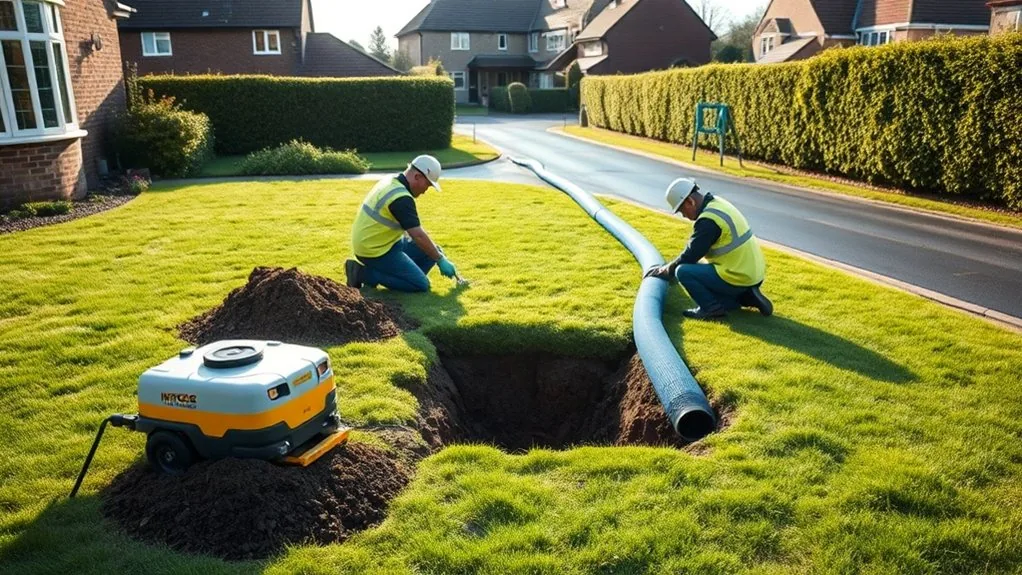
Need to install new water pipes, ducts, or cables beneath drives, roads, or gardens without causing disruption or mess? Impact moling offers a trenchless solution that minimises surface damage and keeps reinstatement costs down across West Malling.
Call now for a fast quote or emergency callout.
Although it’s often described as “trenchless digging,” impact moling is more precisely a guided, pneumatic boring method that drives a torpedo-shaped steel mole through the ground to create a narrow underground passage for pipes or cables. You’ll typically launch the mole from a small entry pit and recover it in a reception pit, avoiding continuous trenches across West Malling’s driveways, gardens, and pavements.
The mole advances by rapid pneumatic hammering, compacting soil rather than removing it. Accurate soil analysis is essential in West Malling, where you may encounter chalk, clay, river gravels, or made ground within a short distance. From this, you’ll determine feasible bore length, depth, and suitable pipe materials—commonly MDPE water pipe, ducts for power or fibre, and occasionally gas-rated polyethylene.
When you’re weighing up how to run new services across a finished landscape in West Malling, you typically turn to impact moling when open-cut trenching would cause excessive disruption, reinstatement cost, or programme risk. You’ll generally need it where surfaces are expensive, sensitive, or heavily trafficked, and where Environmental impact and Cost efficiency are both under scrutiny.
You’ll especially consider impact moling when you must:
When you book impact moling in West Malling, your contractor will follow a precise step‑by‑step process: setting out entry and exit pits, calibrating the pneumatic mole, and driving it through the soil along the planned alignment. You’ll see specialist equipment in use – compressors, tracking and monitoring devices, and reinstatement tools – all selected for the county’s mixed chalk, clay, and gravel ground conditions. Throughout, the team will control ground entry and exit points, constantly checking line, depth, and air pressure to maintain safety and accuracy around existing utilities.
Before any impact moling work starts on your West Malling property, the process is broken down into a precise sequence to control accuracy, minimise disruption, and protect existing services. First, plans, utility records, and local Urban planning constraints are checked so you avoid clashes with other buried infrastructure and reduce Environmental impact. Trial holes are then excavated to expose key services.
Next, entry and exit pits are set out to a tight line and level, allowing for West Malling’s varied ground conditions, from chalk in Medway to clay in Ashford. The bore path is calculated to maintain cover under drives, roads, or landscaped areas.
| Stage | Objective | Local Consideration |
|---|---|---|
| Survey | Map services | KCC records |
| Set-out | Define path | Driveways, trees |
| Bore | Create passage | Stable soils |
With the route planned and pits set out, impact moling in West Malling comes down to using the right kit for the ground under your feet. You’ll rely on a pneumatically driven mole, powered by a compressor sized to your soil conditions and bore length. In West Malling’s mixed chalk, clay, and gravel, you need adjustable striking power and interchangeable heads to keep the bore true.
You’ll also use laser or digital tracking to monitor alignment, plus hose reels, lubricants, and dewatering pumps where water tables are high. Rigorous equipment maintenance is essential to avoid mid-run failures beneath driveways or highways. Modern innovations, like smart moles with pressure feedback and auto-lube systems, help you achieve cleaner, faster, and more predictable installations.
Ever wondered what actually happens between that first pit and a finished underground bore in West Malling? You’ll start with a compact launch pit, typically 1–1.2 m deep, dug just below your existing or proposed service line. The mole’s aligned precisely toward the reception pit, accounting for local soil stability in clay, chalk, or mixed gravels common across West Malling.
From launch to breakout, compressed air drives the mole forward, compacting, not removing, material. That keeps surface disruption minimal and helps reduce environmental impact versus open-cut trenches.
| Stage | What Happens |
|---|---|
| Survey & marking | Map services, confirm route and depth |
| Launch pit formation | Excavate controlled entry pit |
| Mole alignment | Set line/gradient to match pipe design |
| Forward progression | Mole compacts ground to form the bore |
| Exit & pit tie-in | Mole emerges; pipe pulled through and connected |
Once the launch and reception pits are in place, the focus shifts to controlling the mole’s path and keeping everyone on site safe. You’ll see strict safety protocols implemented first: CAT and Genny scanning of existing utilities, service drawings checked against West Malling’s local authority records, and exclusion zones set up around the pits.
Next, the team calibrates the impact mole. They’ll use laser alignment or digital level systems to set grade, then confirm with trial shots. During drilling, constant air pressure and stroke-rate monitoring help keep the mole stable in West Malling’s mixed chalk, clay, and gravel.
Regular depth checks, communication between pit operatives, and contingency plans for obstructions all form part of robust accuracy measures and site-specific risk controls.
Although both methods aim to install or replace underground services, impact moling and traditional open-cut excavation differ radically in how they affect your West Malling property, project timescales, and overall risk. With impact moling, you typically need only small launch and reception pits, so you avoid long trenches across driveways, gardens, or paved forecourts common around West Malling’s older housing stock.
From an Environmental impact perspective, moling disturbs far less soil, reduces cart-away waste, and limits disruption to tree roots and established planting. It also cuts vehicle movements on West Malling’s often-congested roads. Traditional excavation, by contrast, requires extensive spoil handling and reinstatement. However, moling demands rigorous equipment maintenance and correctly sized moles to handle local chalk, clay, and gravel strata without deviation or stoppages.
When you weigh up trenchless options for working under West Malling’s driveways, gardens, and highways, impact moling stands out for delivering precise service runs with minimal surface disruption, shorter programme durations, and tighter cost control. You’re getting an installation method that’s engineered for West Malling’s mixed chalk, clay, and gravel strata, while avoiding the delays and reinstatement issues tied to open-cut trenches.
Across West Malling’s housing estates, farmsteads, business parks, and town centres, impact moling provides a controlled way to install new or replacement services exactly where they’re needed without dismantling finished surfaces. In domestic settings, you’ll use moling for water main upgrades, new-build connections, outside taps, EV charger feeds, and irrigation lines, all while protecting driveways, patios, and carefully planned garden landscaping.
On commercial and agricultural sites, impact moling lets you route fire mains, data ducts, process water, and private supplies beneath access roads, car parks, and loading yards with minimal disruption to trading or operations. Because there’s no open trench, you markedly reduce spoil removal, vehicle movements, and reinstatement materials, cutting both project costs and environmental impact across West Malling’s varied ground conditions.
From initial site survey to final connection and chlorination, our impact moling service is set up to deliver precise, low‑disruption installations anywhere in West Malling, whether you’re on chalk in Dover, clay in Maidstone, or mixed made‑ground in the Medway towns. We design each bore route around buried services, highway constraints, and your programme, so you avoid open‑cut trenches, traffic lights, and reinstatement delays.
You’ll get a tightly controlled process: depth‑checked pilot pits, calibrated moles matched to soil conditions, and continuous tracking to maintain line and gradient for water, power, data, or irrigation runs. We address Environmental concerns by minimising spoil, noise, and vehicle movements. Rigorous equipment maintenance schedules reduce breakdown risk, ensuring predictable, efficient delivery across West Malling’s varied sites.
Because impact moling is only as good as the team planning and steering it, you’ll be working with engineers who understand both West Malling’s ground conditions and the practical constraints of live sites. We survey local soils, buried services, and access limits before specifying bore diameter, route, and pipe material, so your new line performs reliably, not just initially, but over decades.
You’ll benefit from calibrated impact moles, tracked per shot for accuracy and productivity, and reinstatement methods that protect drives, verges, and hard landscaping. We integrate trenchless technology with conventional techniques where needed, minimising risk around utilities and highways. From low‑pressure water supplies to higher‑duty ducting, we design installations that match flow, loading, and future maintenance needs across West Malling’s varied terrain.
You’ll naturally want clear answers on how long impact moling takes, whether it actually works out cheaper than open-cut trenching, and if your part of West Malling is within our core service area. In the next section, we’ll set out typical installation times based on ground conditions, compare whole-of-project costs against traditional excavation, and explain how our coverage spans key towns and rural locations across the county. This helps you assess feasibility, budget, and logistics before you commit to any trenchless works.
Most domestic impact moling jobs in West Malling are completed within a few hours, but the exact duration depends on ground conditions, service length, and access constraints. In compact chalk or stable clay, you’ll typically see 10–15 metres installed in under half a day. Softer gravels, high water tables, or buried obstructions can extend working time because the moling path must be adjusted.
From an Environmental impact perspective, the shorter on-site duration means reduced machine hours, lower fuel use, and fewer lorry movements through West Malling’s narrower residential roads. When you’re carrying out a Cost analysis, remember that total project time isn’t just drilling: setting up launch and reception pits, calibrating levels, and pressure-testing the new pipework all factor into the overall timescale.
Although every project in West Malling has different constraints, impact moling is often cheaper than open-cut trenching once you factor in reinstatement, traffic management, and programme risk. When you carry out a realistic cost comparison, it’s not just the excavation that matters; you’ve also got grab lorries, spoil removal, backfilling, compaction, and surface reconstruction to pay for.
With impact moling, you typically reduce labour hours, plant hire, and reinstatement across tarmac, block paving, and landscaped areas common in West Malling properties. Fewer open trenches mean lower traffic management costs on narrow village roads and busy commuter routes. You’ll also see savings from shorter programme durations and reduced disruption claims. As a bonus, the smaller excavation footprint cuts environmental impact and waste disposal charges.
Cost advantages only matter if a contractor can actually reach your site, so it’s natural to ask whether we cover your part of West Malling. We do. Our impact moling teams operate across the county, including Maidstone, Medway, Ashford, Canterbury, Tonbridge and Malling, Sevenoaks, Swale, Thanet, Dover, and Folkestone & Hythe.
Because West Malling landscaping and soil conditions vary from chalk downs to heavy clay, we adjust moling pressure, tool size, and compressor output to suit your ground conditions and pipe specification. Before scheduling work, we’ll review plans for existing underground utilities, confirm service depths, and agree drill paths that avoid conflict with gas, water, electric, and telecoms. Share your postcode and service requirements, and we’ll confirm availability, access needs, and timescales.
Yes, impact moling can be carried out during winter and heavy rain. However, saturated or frozen ground affects bore stability, steering accuracy, and spoil management. Adjustments such as modifying entry depth, using more robust compressors, applying dewatering or sump pumps, and scheduling works around peak rainfall are necessary. Proper risk assessments and local ground surveys help ensure the mole tracks correctly and avoids service strikes.
Before the Impact Moling team arrives, clear your property by removing any obstacles around the entry and reception pits. Ensure all access points are free from vehicles, bins, logs, and garden furniture. Mark any underground services if you have records from West Malling utilities and expose known inspection chambers. Secure your pets and inform your neighbours about brief noise and compressor use during the work. Provide indoor access to stopcocks and consumer units if system isolation is needed.
Impact moling creates minimal vibration inside nearby buildings. The noise is similar to distant roadworks and is not continuous like drilling. We assess local ground conditions in West Malling and adjust equipment and scheduling to reduce any disturbance, especially if sensitive equipment is present.
Yes, there are strict restrictions on impact moling near trees and protected root zones. An arboricultural impact assessment and compliance with BS 5837 are usually required, along with clearance from the local West Malling planning authority. Common solutions include repositioning launch pits outside the root protection area, using shorter or shallower shots, or employing hand-digging and vacuum excavation near important roots.
Yes, existing utilities can usually be upgraded using impact moling without interrupting services. In West Malling, engineers locate buried services and install new ducts or pipes alongside live lines, switching connections during a short planned outage. This trenchless method reduces risks to gas, water, power, and data cables, and reinstatement is typically quick with proper phasing and temporary bypass supplies.
Ready to see if impact moling is the right solution for your West Malling property? Share your postcode, pipe route length, required depth, and pipe diameter, and we’ll prepare a precise specification-based quote. We’ll also ask about ground conditions (chalk, clay, made ground) and any utilities already present.
Your estimate includes a clear cost analysis: mobilisation, moling runs, materials (MDPE, ducting, fittings), connection works, and reinstatement. You’ll see how impact moling compares with open-cut excavation on programme duration, reinstatement costs, and environmental impact.
Site-specific West Malling factors are always considered—high water tables, conservation areas, highways restrictions, and access constraints in towns and villages. You’ll receive a written, itemised quotation and proposed schedule, so you can plan budget, approvals, and downtime with confidence.